
Warning: contains spoilers for Arcane through season 2.
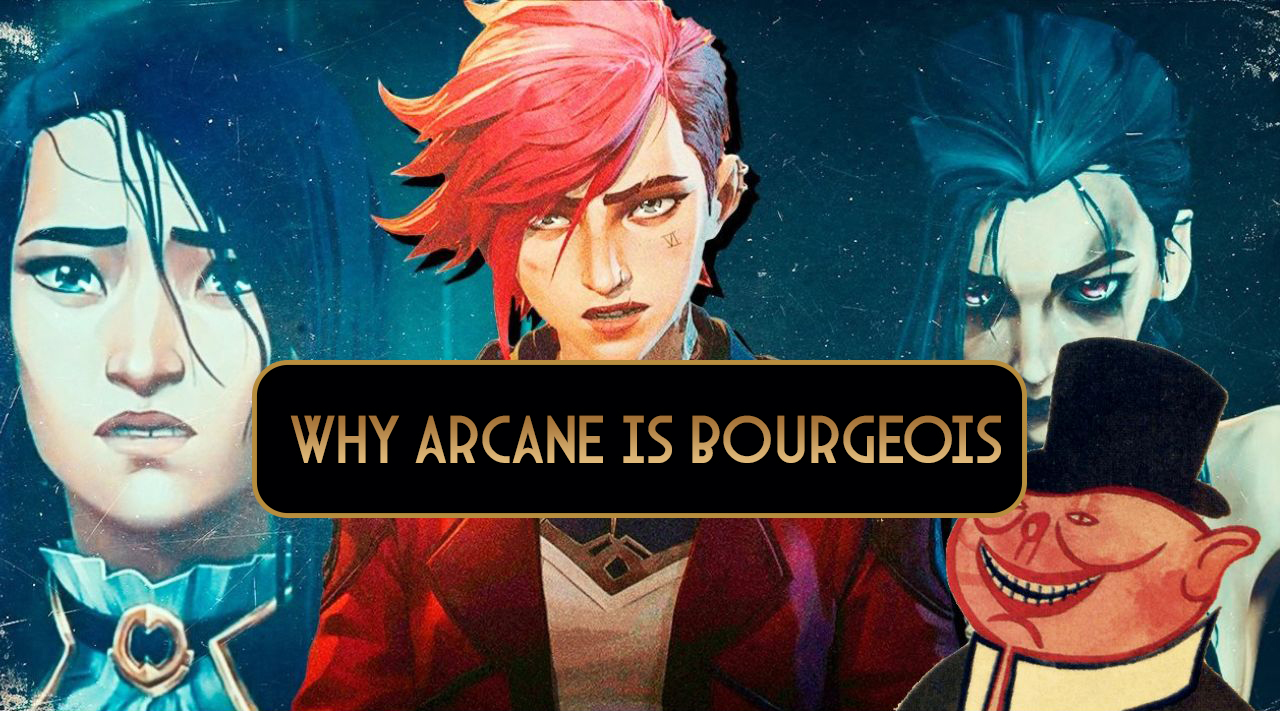
Now that the dust has settled on the Arcane series, I’ve had some time to reflect back on it. From the beginning, I was captivated by its world-building, the depth of the character drama, the beauty of the animation. In a word, I sincerely did enjoy it (mostly for JayVik). And yet there’s a nagging feeling I’ve been carrying with me throughout the series that something isn’t quite right, something subtly sinister about how the show portrays the nature of conflict. You see, the true tragedy of Arcane is not the characters that died or the grand dreams and aspirations that went unfulfilled. No: The true tragedy of Arcane is that for all its ostensibly sympathetic depictions of the class struggle between the oppressed of Zaun and the elites of Piltover — the suffering of the poor, the brutality of the enforcers, the ego, greed, and imbecility of the nation’s rulers — despite it all, the overarching narrative can’t help but be overwhelmingly bourgeois.
Arcane is by no means unique for that. It would certainly be unusual if a multi-hundred-million-dollar production didn’t reflect the values of the society that produced it. All the same, I have to mourn the potential of an even greater story, one that lives up to the revolutionary resistance of the Zaunites against their oppressors, one that gives hope to those suffering injustice today, in place of a story about how war, injustice, and suffering are fundamental to the human experience, and that the best we can strive for is a gradual, Sisyphean struggle against them nonetheless.
And that truly is the message of Arcane. This much is spelled out repeatedly throughout the second season. What is it that every character, topside or undercity, has in common? They are pursuing some good end, for someone or something they love, by ethically questionable means, to horrible consequences. Singed, aka Dr. Reveck, practically turns to the audience to tell us this: “Why does anyone commit acts other deem unspeakable? For love.” The doctor, it would appear, is right. Vander sacrifices the resistance against Piltover to protect Vi and Jinx, becoming the enforcer’s lapdog. Marcus the corrupt cop becomes Silco’s lackey to protect his daughter. Silco pursues power at all expense to free Zaun from Piltover — only to later make the same decision he resented Vander for making. Is there anything so undoing as a daughter? Jayce and Viktor invent hextech to bring magic to the working people, to help those in need, but only end up empowering the wealthy of Piltover even more (not to mention killing Skye, polluting Zaun, starting an arms race, etc etc). Even Ambessa, the most ruthless character in the show, who is presented unambiguously as a fascistic dictator, is shown in the end to just want to protect her family from the black rose. And so on, and so forth. Time and time again the show repeats this age-old cliche: the road to hell is paved with good intentions.
This is the thread that connects every character’s struggle together. This is the “message hidden within the pattern.” Viktor, as the Herald, spells this out quite explicitly when he explains why this pattern repeats itself, universally, everywhere and everytime:
I understand now. The message hidden within the pattern. The reason for our failure in the commune. The doctor was right. It’s inescapable. Humanity. Our very essence. Our emotions. Rage. Compassion. Hate. Two sides of the same coin, inextricably bound… That which inspires us to our greatest good… is also the cause of our greatest evil.
And here,
They want better lives, but emotion clashes with reason: Humanity’s self-corrupting contradiction.
And here,
It is the answer you and I pursued all our lives. An end to cruelty, injustice… [our] baser instincts … spur us to division, death, war, prejudice… but we can be of one mind, united.
In other words, Viktor has concluded that human nature is the root of all evil, and so, in order to purge that evil, we must shed our humanity — our individuality, our freedom, our choice — and “evolve.” Or to put it another way: class conflict is only but one manifestation of the more fundamental conflict between emotional individuals.
If it isn’t obvious from his curiously out of place slavic accent, the commune, and his talk of a destined “glorious evolution,” Viktor, in his final form as the Machine Herald, is intended to be a caricature of a communist revolutionary: idealistic, naive, collectivistic, creating evil to destroy evil. Naturally, since the Machine Herald is a villain, we’re also intended to disagree with him — but what exactly does the show disagree with? We get the answer from Jayce, who, crucially, never actually rejects Viktor’s presumptions about the fundamental cause of conflict. He, and, by extension, the writers, takes it for granted that human nature truly is the cause of war, injustice, and all suffering. They only really diverge on this point: that humanity, despite its flaws, despite its evil, is also the source of all that is good, and therefore must be preserved.
But what does it mean to say that human nature is the root of all war and suffering, but that it needs to be preserved? Only that war and suffering are everlasting and necessary. This, in my view, is the fundamental bourgeois conceit of Arcane. It teaches that the way things are, are they way that things have always been and will always be — that the violence of the status quo must be accepted and that violence against it should be rejected. The final line of dialogue from Caitlyn Kirramen only cements that this, indeed, is the fundamental theme of the show: “we are doomed to revisit the error of our ways, [and] spark ever more conflicts.” Certainly a useful teaching for those who benefit from the status quo — to speak nothing of those who want to profit off future sequels!
Hence the tragedy. For all of Zaun’s suffering and sacrifice, in the end it amounts to nothing. Their struggle is in vain. Nothing gets resolved. The Zaunites don’t get their independence. They don’t get their freedom or access to the hexgates. The pollution and squalor isn’t cleaned up. The scarcity isn’t overcome. Worse than that — their struggle is all but swept under the rug, not even once being mentioned in the finale, with all hope for the future thoroughly repudiated. All that has actually changed is that they were granted a seat — one seat — on the Piltover council. Heimerdinger and Vander, the two wizened old men of the topside and the undercity respectively, are proven to be right when they caution against upsetting the status quo, even if it means accepting all the evils entailed by it. How bleak.
The truth is that you are a denizen of Zaun, and we need not accept the rule of Piltover. Despite what Vander says, we aren’t destined to lose that fight. We need only build the revolutionary party — the missing link in Zaun’s struggle for freedom.
Discover more from Lavender Press
Subscribe to get the latest posts sent to your email.
