
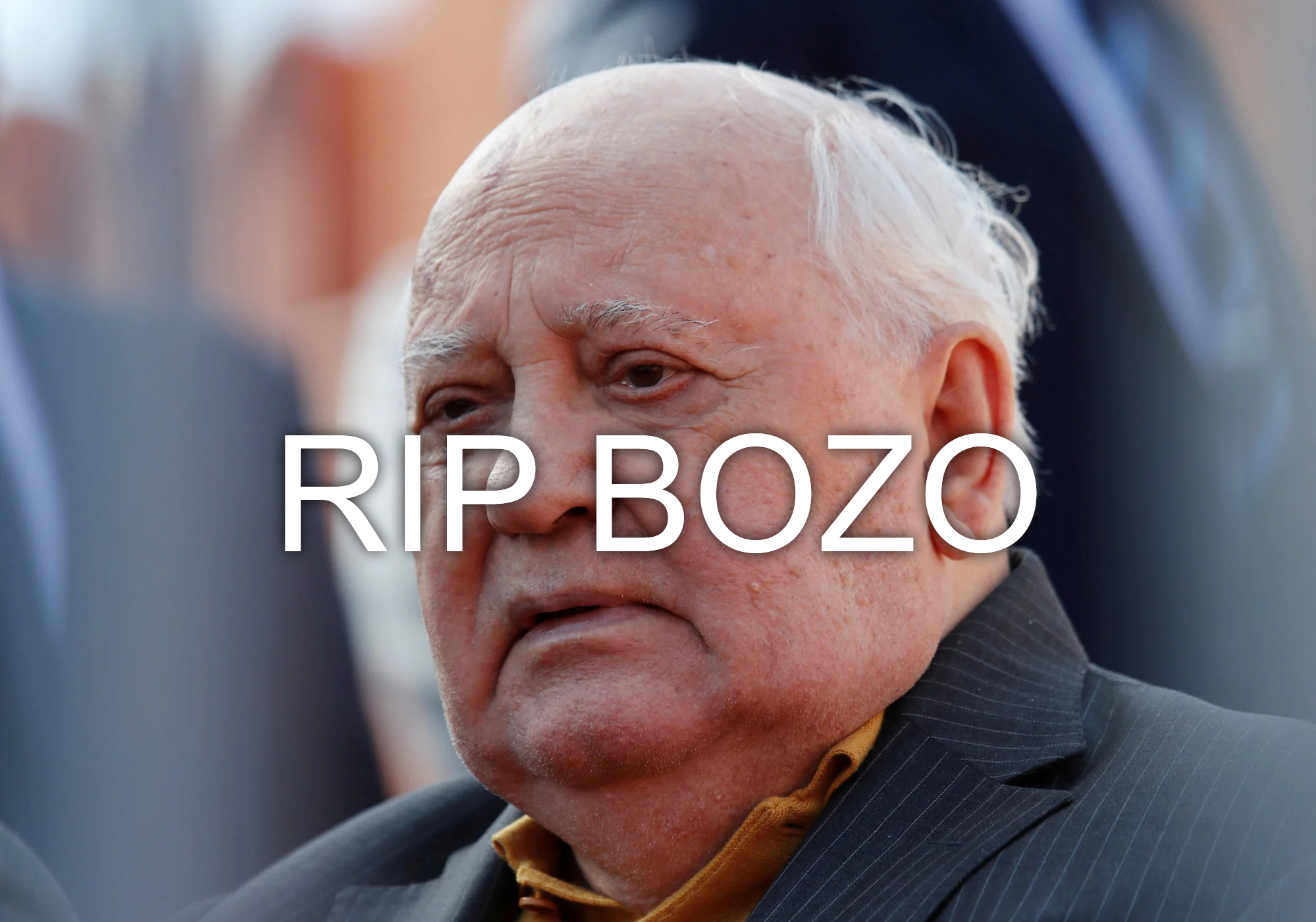
On August 30, 2022, Mikhail Gorbachev, the former president of the Soviet Union, died at the ripe old age of 91. Like many evil men before him, the greatest tragedy of his death was that it wasn’t any sooner. Despite the efforts of the capitalist press to lionize him in death, to celebrate his legacy, we are confident that the long arm of history will reveal to the masses that this despicable man is no hero. Why are we celebrating Gorbachev’s death? Who was he, and what did he do? In short, Gorbachev’s incompetence resulted in the immediate fall of the Soviet Union in 1991, and, ultimately, in the presidency of Vladimir Putin (and thus, by extension, the ongoing war in Ukraine).
While Gorbachev alone could not be sincerely honored as the sole, decisive factor in the fall of the Soviet Union, his incompetent leadership certainly hammered the final nail in the coffin. He was, in other words, the most proximate cause. When Gorbachev came to power in 1985, he inherited a country already beset by economic stagnation and a party rife with corruption. His first major mistake was naively attempting to reconcile with the imperialist nations. He offered concessions to the West, such as allowing the communist German Democratic Republic to be reunited with West Germany under the capitalist system, which betrayed the international revolution for no return. Western powers never returned the favor and only continued their campaign of encirclement and economic warfare. The second major blunder was the infamous Chernobyl disaster, in which a nuclear power plant not only melted down but was subsequently covered up as well. However, the most decisive mistake was Gorbachev’s attempts at reform: perestroika (“restructuring”) and glasnost (“openness”). Both of these policies had disastrous results and far-reaching consequences.
Perestroika
The 1980’s birthed a new economic theory known as neoliberalism. In truth, the neoliberal movement was more like a revival of laissez-faire economics. It is an economic theory, though perhaps more accurately a dogma, that says that the free market is objectively the best method for achieving growth and for distributing resources efficiently. Specifically, it advocates for privatization, deregulation, and free-trade. Capitalizing on the economic instability of the 70’s, financial elites sought to overthrow the dominant Keynesian fiscal policy with one that took wealth and power back from the capitalist state and redistributed it back into the hands of individual capitalists. Amidst this development, U-Chicago’s economic school concocted what later came to be called “shock-therapy,” a doctrine practically crafted to destroy socialist economies. It promoted the idea that transitioning from a planned economy to a neoliberal market economy overnight would solve economic crisis and stagnation, and was first employed by the fascist Pinochet regime that toppled socialist Chile.
It is based on the above ideology that Gorbachev instituted a policy of perestroika—restructuring. Firms were decollectivized and turned into essentially private coops competing against each other within a market system. The planned economy which had once guaranteed employment to every citizen was partially destroyed, causing unemployment to rise. He also allowed foreign capitalists (AKA imperialists) to invest their capital into the Soviet economy, leading to this infamous commercial in which Gorbachev is hailed as a hero for bringing Pizza Hut to Russia:
The reforms did nothing to reverse the stagnation of the economy. It did, however, earn Gorbachev the praise of then-president Bush (senior), who said:
I’ve expressed my keen interest in seeing perestroika succeed. Gorbachev is the architect of perestroika… I salute the man for what he has done.
The President’s News Conference, 1990
Glasnost
The economic reforms certainly didn’t help, but they were ultimately indecisive in creating the crisis that would destroy the USSR. That honor belongs to glasnost, Gorbachev’s political reforms which he claimed would increase transparency, accountability, and democracy. The actual impact of this policy, however, was the empowerment of reactionary, fascistic, and violent nationalist movements. Gorbachev himself has gone on record blaming the fall of the USSR on Chernobyl. In our opinion, this is only true to the extent that it provided a pretext for glasnost.
The newly privatized press, operating on a for-profit basis, immediately sensed that they could generate profits through dramatization, fearmongering, and inflammatory reporting. They published divisive us-versus-them narratives, breaking down class solidarity among the Soviet republics, while new nationalist parties gained power and advocated for secession. Rather than “workers of the world unite,” they declared that different nations could not be united together peacefully, and a few even declared independence. The remaining republics held a referendum on the preservation of the USSR on March 17, 1991. The results were overwhelmingly in favor of preservation, with results ranging from 70% in favor up to 97% in favor:

Despite overwhelming support for preserving the union, one man in particular took advantage of this political destabilization: Boris Yeltsin. In some ways, Boris Yeltsin was a bit like the Donald Trump of the Russia: he was an elite opportunist who sought to make himself out as some kind of anti-establishment figure despite being very much of the establishment. Taking advantage of the growing nationalist opposition, Yeltsin became the figurehead for the Russian Nationalist movement, which wanted its own independence from the USSR.
With Gorbachev failing to maintain control and Yeltsin’s influence growing rapidly, hardline communist loyalists in the Red Army attempted a coup on the 19th of August, arresting Gorbachev and attempting to assassinate Yeltsin as well. Their efforts failed. On December 25th, Gorbachev formally resigned. The flag of the Soviet Union was lowered from the Kremlin and replaced with the tricolor flag of the Russian Federation. The next day, the Soviet Union was officially declared over.
Immediate Consequences
Yeltsin came to power of the new Russian Federation, rewarding his loyalists who would become the new oligarchs by splitting up Russia’s assets among themselves. Finally, shock-therapy truly in practice! The immediate results were predictably catastrophic. The complete shift to a capitalist market economy and the removal of price controls caused GDP to drop precipitously, leading to intense shortages. Those shortages, plus rising unemployment and the loss of social welfare (including healthcare) caused life expectancy to drop. Suicide, drug use, prostitution and human trafficking sky-rocketed. To this day human trafficking of sex slaves from eastern Europe remains an issue precisely because of the dissolution of the Soviet Union. It was, in short, an unmitigated disaster for all except the new oligarchs.


Then in 1993, Yeltsin led yet another coup in an event known as the “Russian Constitutional Crisis” in which he had the army shell the parliament with tanks, killing 147 and wounding over 400. This allowed him to further consolidate power by rewriting the constitution and banning all leftist organizations and newspapers.
How Putin Came To Power
Despite all of Yeltsin’s best efforts, his reputation was irreparable. Besides the disastrous economic crises and reduction in quality of life under his rule, various corruption scandals leaked revealing for all to see that he was personally benefiting from the turmoil. Looking to avoid consequences, Yeltsin put his most loyal acolyte in charge: Vladimir Putin. Subsequently, Putin pardoned Yeltsin of all his crimes and ensured that he remained untouchable. And the rest, of course, is history.
The fall of the USSR was one of the worst tragedies of the 20’th century, the shadow of which we are still living in. And with the looming threat of great power conflicts re-emerging let us remember how we got here: though we have focused on Gorbachev’s particular role in the dissolution, let us not forget the contribution of the US and other imperialist powers who fought for a century to destroy the USSR. Let us not forget that, every time the US government and media bangs the war drums against Russia today, it was their intervention that put Putin into power in the first place. Today, Russian anti-imperialist protesters are arrested for opposing the wars of the Russian Federation; therefore, let us extend solidarity to the people of Russia who are every bit a victim of their government as anyone else, who are fighting for a brighter future, fighting for a restoration of socialism and an end to imperialism. Putin’s regime WILL be toppled—by the people of Russia. Let us not forget that we too live in an imperialist regime—indeed one much bigger and stronger than Russia. Thus, we must oppose our own imperialist ruling class at the same time that Russians oppose theirs. It is not a fight of Russians against Americans, but a fight by the working classes of every nation against the ruling classes of the world; we are all in this together, united by a common cause: socialism.
Discover more from Lavender Press
Subscribe to get the latest posts sent to your email.

